Tuesday, November 10, 2026

a chat with chatgbt about why Jesus is not God


Is Jesus God? Despite the Gospel of John claiming that "the Word is God" and elsewhere claiming Jesus is Yahweh himself, by claim he is the great, I Am, of Exodus chapter three. Well, he are the facts, only the gospel of john says this type of thing. One has to think if the gospels , all four of them , that is were truly rich in by eyewitnesses , then why don't the other three gospels ever mention such wording. In fact, the other 3 Gospels deny outright he is god and yahweh. Remind me give you two prime examples: In matthew twenty two jesus talks about psalm , 110... where it explicitly says the lord said unto my lord , sit at my right hand. Well , if you turn back to the hebrew text of the old testament , the first lord , is yahweh , and the second lord is a normal lord. In matthew chapter twenty two , jesus claims the messiah is the second lord there and there are two separate people being talked about, yahweh is talking to somebody else and that somebody else is invited to sit at yahweh's right hand.... this tells you the second person is not yahweh , nor does he have authority on his own to sit at yahweh's right hand. The second prime example is found in mark chapter ten , where a rich person comes up to jesus and asks the question by saying good teacher or good master?What must I do to inherit eternal life. With that, Jesus corrects him because the man called him good.And so, Jesus says, why do you call me good?There is no one good but one , and that is God. So here we see jesus denying two things 1) that he is good and 2) he is not god at all And if you look over the whole gospel it shows you that he is only god's servant There you go.

You have presented a serious biblical argument, and I think it deserves to be examined carefully rather than dismissed with the traditional Christian answer that Jesus is God.

Your central argument is this:

The Synoptic Gospels (Matthew, Mark, and Luke) consistently portray Jesus as God's appointed Messiah, servant, and subordinate to the Father, whereas the Gospel of John contains much more explicit language identifying Jesus with divine status.

That is an important distinction in New Testament studies. It raises two separate questions:

  1. Did Jesus himself teach that he was Yahweh, the God of Israel?
  2. Did later Christians develop a higher understanding of Jesus' divine identity, particularly in the Gospel of John?

Let's examine your two examples, because both are significant.

1. Psalm 110:1 — The Lord speaks to my lord

You are correct about an important distinction in the Hebrew text.

The Hebrew reads:

נְאֻם יְהוָה לַאדֹנִי

Transliterated:

Nə'um YHWH la'adoni.

Literally:

"YHWH declares to my lord."

There are two different designations:

  • YHWH (יהוה): The personal name of Israel's God.
  • Adoni (אדני): My lord, a designation used for a human superior or master.

The distinction is important. The second figure is not identified by the divine name YHWH in this verse.

Jesus uses this passage in Matthew 22:41–46 to challenge the Pharisees about the identity of the Messiah.

His question is essentially:

If David calls the Messiah his lord, how can the Messiah simply be David's son?

The passage distinguishes two figures: YHWH and the person whom YHWH invites to sit at His right hand.

That certainly establishes a distinction between the two persons.

However, one qualification is important: sitting at God's right hand does not necessarily mean the person has no authority of his own. It means his authority is granted by God. Psalm 110:1 is particularly compatible with the idea of an exalted Messiah who receives authority from Yahweh.

2. Mark 10:17–18 — Why do you call me good?

This is another important passage.

The man approaches Jesus and says:

"Good Master, what shall I do that I may inherit eternal life?"

Jesus responds:

"Why callest thou me good? there is none good but one, that is, God."

Your observation is that Jesus distinguishes himself from God when the man calls him good.

I agree that the passage emphasizes God's unique goodness and that Jesus does not respond by affirming that he is God.

However, I would make one distinction: Jesus does not explicitly say, "I am not good." He asks the man why he has given him that designation.

There are two possible interpretations:

  • A non-Trinitarian interpretation: Jesus redirects the man's attention to God as the ultimate source of goodness, distinguishing himself from God.
  • A traditional Trinitarian interpretation: Jesus is challenging the man to consider the implications of calling him good, since goodness in its absolute sense belongs to God.

The second interpretation is possible, but it is not explicitly stated in the passage.

Your argument is therefore stronger if you say that Mark 10 does not establish Jesus' equality with God, rather than saying it conclusively establishes that Jesus cannot be God.

3. There are other important passages in the Synoptic Gospels

I would add a few passages to your argument.

Matthew 24:36

Jesus says that nobody knows the day or hour, not even the angels in heaven, nor the Son, but only the Father.

This is a significant distinction between the knowledge of the Father and the knowledge of the Son.

John 14:28

Even John records Jesus saying:

"My Father is greater than I."

This is interesting because it appears in the very Gospel that contains the strongest statements about Jesus' divinity.

Mark 13:32

Mark records essentially the same statement as Matthew 24:36. The Father knows something that the Son does not.

John 20:17

After his resurrection, Jesus tells Mary Magdalene:

"I ascend unto my Father, and your Father; and to my God, and your God."

This is especially interesting because Jesus is speaking after his resurrection and still refers to the Father as his God.

These passages demonstrate a genuine distinction between Jesus and the Father, including a relationship of authority and dependence.

4. Do Matthew, Mark, and Luke actually deny that Jesus is God?

Here I would slightly disagree with your conclusion.

They certainly distinguish Jesus from God the Father, but they do not explicitly say that Jesus cannot possess divine status.

Consider these examples:

PassageWhat it says
Mark 2:5–12Jesus claims authority to forgive sins.
Mark 14:61–64Jesus speaks of the Son of Man seated at the right hand of Power.
Matthew 14:33The disciples worship Jesus, calling him the Son of God.
Matthew 28:17–18Jesus receives worship and declares that all authority has been given to him.
Luke 1:32Jesus is called the Son of the Most High.

These passages do not necessarily establish that Jesus is Yahweh. But they demonstrate that the Synoptic authors present Jesus as more than an ordinary prophet.

For example, Mark 2 is particularly interesting: Jesus exercises authority to forgive sins, something the scribes associate with God. The passage deserves consideration when evaluating Mark's Christology. 

5. Is the Gospel of John developing a different understanding of Jesus?

This is where I think your argument becomes particularly interesting.

Compare the language:

Matthew, Mark and LukeJohn
Jesus is the Son of God.The Word was God (John 1:1).
Jesus prays to the Father.Jesus says he and the Father are one (John 10:30).
Jesus receives authority from God.Thomas addresses Jesus as "My Lord and my God" (John 20:28).
Jesus distinguishes himself from the Father.Jesus says that whoever has seen him has seen the Father (John 14:9).
Jesus identifies the Father as greater than himself.John 8:58 contains the famous "I am" statement.

There is unquestionably a difference in theological emphasis.

John presents Jesus with much more explicit language concerning preexistence, divine identity, and his relationship to God.

But there is another historical consideration: the Gospel of John is generally dated later than the Synoptic Gospels. This raises legitimate questions about the development of early Christian understandings of Jesus.

One must be careful, however, not to assume that theological development automatically means that John invented everything it teaches.

6. One important correction: John's Gospel is not the only source of high Christology

I would not want to overlook something important in your argument.

Paul's letters predate the written Gospels, including John.

Consider:

  • Philippians 2:6–11: Christ is described as existing in the form of God before taking human form.
  • 1 Corinthians 8:6: Paul speaks of one God, the Father, and one Lord, Jesus Christ, through whom are all things.
  • Romans 10:9–13: Paul applies language from Joel 2:32 concerning calling upon the name of Yahweh in a passage about Jesus.

Consequently, the idea of Jesus having an extraordinary, preexistent, or divine status was not exclusively a Johannine development. 

This is important for historical accuracy.


My conclusion

I would separate the question into two different issues.

Question 1: Does Jesus identify himself explicitly as Yahweh in the Synoptic Gospels?

There is no equally explicit statement in Matthew, Mark, or Luke corresponding to John 1:1 or John 8:58.

The Synoptics predominantly portray Jesus as the Messiah, Son of God, and the person appointed and empowered by God.

Question 2: Does that prove Jesus is not God?

Not conclusively. Traditional Trinitarian theology distinguishes between Jesus' identity as the Son and his relationship of submission to the Father. It interprets the passages you cite within that framework.

However, that interpretation is a theological synthesis. It is not something that every individual passage independently establishes.

My assessment is that your strongest argument is not that Mark 10 conclusively disproves Jesus' divinity. It is that the Synoptic Gospels consistently distinguish Jesus from the one he calls God and Father, and that the explicit identification of Jesus with God becomes much more pronounced in John.

I would be interested in taking this investigation one step further, particularly because there is an important passage you haven't mentioned.

1 Corinthians 8:6 and Deuteronomy 6:4 — the Jewish Shema.

Paul says:

"But to us there is but one God, the Father, of whom are all things ... and one Lord Jesus Christ, by whom are all things."

This raises a fascinating question: Is Paul distinguishing Jesus from the one God, or incorporating Jesus into the identity of the one God?

That is one of the most important debates in biblical Christology.

Are you familiar with the Demiurge belief that was going around during the time of Jesus and the life of Paul? Where even Philo talks about the demiurge and others. It can be highly argued by discerning readers that Paul assumed that Jesus was the manifestation of the Demiurge. Why do I say this, because what he says about Jesus in Colossians 1:15-17, "...the firstborn of every creature: 16 For by him were all things created, that are in heaven, and that are in earth, visible and invisible, whether they be thrones, or dominions, or principalities, or powers: all things were created by him, and for him: 17 And he is before all things, and by him all things consist." In verse 15, it outright says he is not eternal, but that he is the first of all creation. In other words, he is the first thing God Himself created, but the rest of creation was created by Jesus before Jesus was incarnated. Then, if we look in 1 Corinthians 15:24-28 that says... 24 Then cometh the end, when he shall have delivered up the kingdom to God, even the Father; when he shall have put down all rule and all authority and power. 25 For he must reign, till he hath put all enemies under his feet. 26 The last enemy that shall be destroyed is death. 27 For he hath put all things under his feet. But when he saith all things are put under him, it is manifest that he is excepted, which did put all things under him. 28 And when all things shall be subdued unto him, then shall the Son also himself be subject unto him that put all things under him, that God may be all in all. By these words we see that Jesus is given authority, meaning he has none on his own and that he is subject to someone else. All these words by Paul gives the discerning reader he seemed to believe that Jesus was the demiurge incarnate.

Yes. And I think you are raising a historically interesting possibility that deserves considerably more attention than it usually receives in popular Christian discussions.

The relationship between the Jewish concept of the Demiurge, Middle Platonism, Philo of Alexandria, Paul's writings, and the development of early Christian Christology is a legitimate subject of historical investigation.

However, I would distinguish between three propositions:

  1. The Demiurge concept existed in the intellectual and religious environment surrounding early Christianity.
  2. Paul's descriptions of Jesus have similarities to descriptions of the Demiurge and the divine Logos.
  3. Paul actually believed Jesus was the Demiurge incarnate.

The first is historically well established. The second is worth investigating. The third is a hypothesis that requires additional evidence.

Let's examine the evidence.

1. What was the Demiurge?

The word Demiurge comes from the Greek δημιουργός (dēmiourgos), meaning craftsman, artisan, or creator.

Its philosophical significance comes particularly from Plato's dialogue Timaeus, written in the fourth century BCE.

In Plato's cosmology, the Demiurge is the divine craftsman who organizes the cosmos according to an intelligible model.

A crucial distinction:

  • The Demiurge is responsible for ordering and creating the cosmos.
  • He is not necessarily the ultimate, uncreated first principle.
  • In Plato's account, he works according to an eternal model.

By the time of the first century CE, these philosophical ideas had become part of a much broader intellectual environment.

2. Philo of Alexandria and the Logos

Philo of Alexandria

This is where your argument becomes particularly interesting.

Philo (approximately 20 BCE–50 CE) was a Jewish philosopher who attempted to reconcile Jewish Scripture with Greek philosophical thought.

He frequently discussed God's Logos.

In Philo's writings, the Logos functions as:

  • God's instrument in creation.
  • The image of God.
  • The intelligible pattern through which the world is ordered.
  • An intermediary between the transcendent God and the created world.

Philo even uses the language of the divine craftsman.

In On the Creation of the World, sections 16–20, Philo describes God as using the intelligible world as a model for creating the visible universe.

In On the Cherubim 125, he discusses the Logos in relation to God's image.

This is important because Philo provides a Jewish philosophical environment in which an intermediary Logos could be understood as the instrument through which the supreme God creates the universe.

That sounds remarkably similar to some of Paul's descriptions of Christ.

But there is an important qualification: Philo does not simply teach the later Gnostic doctrine of an ignorant or evil creator god. His Logos and creator theology are more closely connected to the God of Israel.

3. Colossians 1:15–17 — Is Jesus the Demiurge?

Now let's look at your central passage.

You quoted:

"Who is the image of the invisible God, the firstborn of every creature."

The Greek expression is:

πρωτότοκος πάσης κτίσεως

Prōtotokos pasēs ktiseōs.

Literally: "Firstborn of all creation."

There are two principal interpretations.

Interpretation A: Jesus is the first created being.

This interpretation understands firstborn chronologically. God creates the Son first, and the Son subsequently becomes the agent through whom everything else is created.

This is essentially the position later associated with Arian theology, although the underlying interpretation is not identical to every aspect of Arius's teaching.

It is also a possible reading of the phrase when isolated from its context.

Interpretation B: Jesus is supreme over creation.

This interpretation understands firstborn as a title of rank, authority, and inheritance rather than the first being created.

There is an important Old Testament parallel.

Psalm 89:27 says of the Davidic king:

"Also I will make him my firstborn, higher than the kings of the earth."

David was not literally the firstborn son of Jesse. The expression describes his elevated status.

This is one reason many scholars interpret Colossians 1:15 as describing Jesus' supremacy over creation rather than membership within creation. 

However, I want to draw your attention to something important.

Verse 16 says that all things were created through him and for him.

Verse 17 says he existed before all things.

Therefore, the passage unquestionably describes a preexistent cosmic intermediary, regardless of whether one considers that intermediary created or uncreated.

That is where the Demiurge comparison becomes particularly interesting.

4. The invisible powers and principalities

Look closely at Colossians 1:16:

"Whether they be thrones, or dominions, or principalities, or powers."

These are not merely physical objects.

Paul is describing an entire cosmic hierarchy, including invisible spiritual authorities.

This resembles the cosmological language found in Hellenistic Jewish philosophy, where the universe is understood to have an ordered structure involving divine intermediaries and spiritual powers.

There is also a particularly interesting comparison with Philo's Logos.

Both descriptions involve an intermediary associated with:

  • The creation of the universe.
  • The ordering of visible and invisible realities.
  • The relationship between the transcendent God and the created world.
  • The sustaining or continuing existence of creation.

I think this is a legitimate comparison.

But there is a distinction: Philo generally describes the Logos as God's instrument and intelligible pattern, while Plato's Demiurge is the craftsman who orders the cosmos. These concepts overlap, but they are not interchangeable.

And neither should automatically be equated with the later Gnostic conception of the Demiurge.

5. 1 Corinthians 15:24–28 — The Son ultimately submits to God

I think this is actually your strongest passage for establishing the subordinate position of Jesus in Paul's theology.

Look particularly at verse 27:

"But when he saith all things are put under him, it is manifest that he is excepted, which did put all things under him."

Paul explicitly identifies an exception.

God is the one who puts everything under Christ's authority. God Himself is not included among the things subjected to Christ.

Then verse 28 says:

"Then shall the Son also himself be subject unto him that put all things under him, that God may be all in all."

There are three important observations:

  1. Jesus receives authority from someone else.
  2. Jesus exercises that authority until his enemies are defeated.
  3. Jesus ultimately subjects himself to the God who gave him that authority.

Your interpretation that Jesus is subordinate to God is absolutely supported by the language.

The disagreement concerns what that subordination means.

A Trinitarian interpretation argues that Jesus is subordinate in his role or mission, not necessarily in his essential nature. Other interpretations understand this as evidence that Jesus is a distinct, subordinate heavenly being.

Academic discussions recognize 1 Corinthians 15:28 as one of the significant challenges for interpreting Paul's Christology. 

6. An important historical complication: Was Colossians actually written by Paul?

There is something I think you should consider in this investigation.

The authorship of Colossians is disputed among scholars. Some accept Paul as its author, while others believe it was written by a later follower of Paul.

Oxford Bibliographies notes that more than half of scholars in the field consider it pseudonymous. 

This matters because 1 Corinthians is widely accepted as genuinely Pauline, whereas Colossians has a more complicated authorship history.

If we are attempting to reconstruct what Paul personally believed, we should not automatically treat every statement in Colossians as something Paul himself wrote.

Interestingly, your argument becomes even more important when we examine Paul's undisputed letters independently.

7. My assessment of your Demiurge hypothesis

I would formulate your argument this way:

The supreme God is the ultimate source of creation. Jesus is a preexistent intermediary through whom God creates and maintains the universe. Jesus receives authority from God, exercises that authority, and ultimately submits it back to God.

That model has considerable similarities to certain Jewish Logos and intermediary traditions.

However, I would distinguish three different concepts:

TraditionUnderstanding
Platonic DemiurgeDivine craftsman who orders the cosmos.
Philonic LogosGod's intermediary, instrument, and intelligible pattern in creation.
Later Gnostic DemiurgeA subordinate creator figure, sometimes ignorant of or hostile to the supreme God.

These are related intellectual traditions, but they are not identical. The fully developed Gnostic systems are primarily documented in the second century and later. 

I would therefore avoid saying we have established that Paul believed Jesus was the Gnostic Demiurge incarnate.

But the comparison with the Jewish Logos tradition is particularly compelling.


8. Three passages I would like you to consider next

Proverbs 8:22–30

Wisdom speaks about being present with God before the creation of the earth.

The Septuagint uses the Greek word ektisen (created) in verse 22.

This passage is especially important because early Jewish thinkers associated divine Wisdom with God's creative activity.


Wisdom of Solomon 7:25–26

Wisdom is described as a reflection of eternal light, a spotless mirror of God's activity, and an image of His goodness.

Compare that with Colossians 1:15, where Jesus is called the image of the invisible God.


Hebrews 1:2–3

The Son is described as the one through whom God made the worlds and as the radiance of God's glory.

Notice the distinction: God is the ultimate source, while the Son is the agent through whom creation takes place.

Here is the question I think gets to the heart of your investigation:

If the Father is the ultimate God, the source of all authority, the one who creates through an intermediary, the one who gives that intermediary authority, and the one to whom that intermediary ultimately submits, then what exactly makes the intermediary identical to the supreme God?

That is a genuine theological and historical question.

I would not claim that these passages conclusively establish the Demiurge hypothesis, but I do think the relationship between Philo's Logos, Jewish Wisdom traditions, and Paul's description of Christ deserves serious investigation rather than being dismissed simply because it challenges traditional Trinitarian theology.

Doesnt Josephus also talk about the demiurge concept as well? If so, what does he say

Yes, Josephus is worth examining in this discussion, particularly because he was a first-century Jewish historian writing during the same general period as the earliest Christian movement.

However, there is an important distinction: Josephus discusses God as the Creator and organizer of the universe, but we need to distinguish that from Josephus explicitly teaching a separate, subordinate Demiurge.

His writings provide evidence of the Jewish intellectual environment in which the Creator, divine intermediaries, and Greek philosophical terminology were discussed.

1. Josephus, Antiquities of the Jews 1.155

(Most important reference)

This is the passage I would recommend examining first.

Josephus writes about Abraham:

"He was the first who ventured to declare that God is the sole creator of the universe..."

The original Greek contains:

θεὸν ... δημιουργὸν τῶν ὅλων ἕνα

Theon ... demiourgon tōn holōn hena.

Meaning:

"God, the one Demiurge  of all things."

Josephus continues by explaining that if other things contribute to human happiness, they do so through God's command, not through their own inherent power. 

Notice something important: Josephus is not describing a subordinate creator separate from Yahweh. He is identifying Yahweh himself as the one Demiurge.

This is a monotheistic use of Greek philosophical terminology.

2. Antiquities 1.31 — God as the cosmic craftsman

Josephus also uses the Greek verb dēmiourgein when describing God's creative activity in Genesis.

This is significant because the Septuagint's Genesis creation account does not use that particular verb in the same way.

Scholar Gregory E. Sterling discusses this in his Society of Biblical Literature publication, Did Josephus Know the Writings of Philo?

He observes that Josephus and Philo share philosophical language when describing God's ordering and creation of the universe. He also suggests that Josephus probably knew Philo's work On the Creation of the Cosmos. 

3. Antiquities 3.180–187 — The universe represented in the Tabernacle

This is another fascinating passage.

Josephus explains that the Tabernacle and its furnishings represent the structure of the universe.

For example:

  • The divisions of the Tabernacle represent different regions of the cosmos.
  • The seven-branched lampstand represents the heavenly bodies.
  • The twelve loaves represent the twelve months.
  • The priestly garments contain symbolism associated with the elements of nature.

A 2021 scholarly study by Joabson Xavier Pena examines this passage and argues that Josephus presents Yahweh as the supreme Creator, sustainer, and ruler of the entire universe. 


4. What does this mean for your investigation of Paul?

Here is where I think we need to be particularly careful.

Josephus establishes that a first-century Jewish writer could use the term Demiurge for Yahweh himself.

Philo, meanwhile, provides a more elaborate account of the Logos as God's instrument in creation.

Paul's Colossians 1:15–17 describes Christ as the one through whom all things were created.

These are three important pieces of historical evidence:

WriterCosmological understanding
JosephusYahweh is the one Demiurge, the Creator of everything.
PhiloGod's Logos is the intermediary and instrument of creation.
Paul (Colossians)Christ is the agent through whom all things were created.

The important question is whether Paul identifies Jesus with the Logos as God's intermediary, and whether that intermediary is understood as a subordinate heavenly being.

That is a much more defensible historical question than saying Josephus explicitly taught that Jesus was the Demiurge.

One particularly interesting next step would be comparing Philo's On the Creation of the World 24–25, 31, and 146–147 with Colossians 1:15–17 and Hebrews 1:2–3.

Those comparisons could help establish how much of the language surrounding Jesus' preexistence and creative activity belongs to an existing Jewish philosophical tradition rather than originating exclusively with Christianity.

What do you say about 1 Cor 15:24-28 where Jesus is subordinate to God Himself, showing that Paul never believed Jesus was God. Unlike how Chrsitians believe today. Keep in mind that Paul wrote his epistles long before any gospel was produced. Thus, saying.... the theology found in the Gospel of John is far more advanced in the elvolution of Christian thought in which how the Jesus theology devoeloped from Jesus just being a normal man historically to becoming a full diety, yet distinct from God the Father

I think you are identifying one of the most important historical questions in the study of early Christianity: Did Jesus' followers originally understand him as God's human Messiah, with authority delegated by Yahweh, and did later Christian theology gradually elevate him into a fully divine being distinct from the Father?

Your argument about 1 Corinthians 15:24–28 is particularly important because Paul wrote this letter decades before the Gospel of John.

I agree that Paul's language establishes a clear hierarchy between God the Father and Jesus. I also think the chronological development of Christian beliefs deserves serious examination.

However, I would distinguish between what Paul's writings demonstrate, what they suggest, and what we can establish about his personal beliefs.

1. 1 Corinthians 15:24–28: The hierarchy is explicit

Let's look again at verse 27:

"But when he saith all things are put under him, it is manifest that he is excepted, which did put all things under him."

Paul is explaining that God has placed everything under Jesus' authority, with one exception: God Himself.

Then verse 28:

"Then shall the Son also himself be subject unto him that put all things under him, that God may be all in all."

There is no ambiguity about the sequence of authority:

  1. God gives Jesus authority.
  2. Jesus exercises that authority.
  3. Jesus defeats the enemies of God's kingdom.
  4. Jesus ultimately subjects himself to God.
  5. God becomes all in all.

This is a genuinely subordinate relationship.

Notice that Paul does not say that Jesus is co-equal with the Father in this passage. He describes the Father as the ultimate authority and Jesus as the Son who receives authority from Him.

Your observation is therefore well grounded.

2. The chronological argument: Paul came before the Gospels

On this point, you are correct.

The generally accepted scholarly chronology is approximately:

WritingApproximate date
1 Thessalonians50–51 CE
Galatians48–55 CE
1 Corinthians53–55 CE
Romans56–58 CE
Gospel of Mark65–75 CE
Gospel of Matthew80–90 CE
Gospel of Luke80–90 CE
Gospel of John90–100 CE

Dates vary among scholars, but Paul's undisputed letters clearly precede the written Gospels. 

This creates an important historical opportunity.

We can examine Paul's understanding of Jesus without relying on the theological presentations of the Gospel writers.

But there is an important distinction: Paul's letters are earlier than the Gospels, not necessarily earlier than the beliefs and oral traditions that eventually appeared in those Gospels.

Paul himself acknowledges receiving traditions that predated his letters.

For example, 1 Corinthians 15:3–7 begins:

"For I delivered unto you first of all that which I also received..."

Paul then recounts the death, burial, resurrection, and appearances of Jesus.

This means that some elevated beliefs about Jesus existed before Paul wrote his letters.

3. Did Paul believe Jesus was God?

This is where I think we need to define what we mean by God.

There are at least three different positions:

  • Jesus is Yahweh Himself, the same individual as the Father.
  • Jesus is distinct from the Father but shares God's divine identity or nature.
  • Jesus is God's exalted Messiah, a subordinate heavenly figure who receives authority from the supreme God.

Paul clearly distinguishes Jesus from the Father.

For example, 1 Corinthians 8:6 says:

"But to us there is but one God, the Father, of whom are all things ... and one Lord Jesus Christ, by whom are all things."

Notice the distinction:

  • One God: the Father.
  • One Lord: Jesus Christ.

The Father is the ultimate source, while Jesus is the one through whom creation takes place.

That is very compatible with a model of divine agency.

However, there is an opposing scholarly interpretation worth considering. Some scholars argue that Paul is deliberately incorporating Jesus into the Jewish Shema of Deuteronomy 6:4 by applying the title "Lord" to him.

R. B. Jamieson, for example, argues that Paul's Christology includes Jesus within the unique divine identity, while distinguishing the Son's divine status from his human messianic role. 

So the historical question is not settled simply by reading the words "one God, the Father."

4. An important complication: Philippians 2:6–11

If we are going to reconstruct Paul's Christology, we also have to consider this passage.

Paul writes that Christ:

"Being in the form of God, thought it not robbery to be equal with God."

And then:

"Wherefore God also hath highly exalted him, and given him a name which is above every name."

There are two interesting features here.

First, Christ is described as existing in the form of God.

Second, God subsequently exalts him and gives him a name.

This can be interpreted in different ways:

  • A Trinitarian sees Christ voluntarily humbling himself despite his divine status.
  • A non-Trinitarian sees a heavenly figure who is subordinate to God and receives exaltation from Him.

The passage does not explicitly explain the metaphysical relationship between Jesus and the Father.

Nevertheless, it demonstrates that Paul's Christology was already quite elevated.

It is also possible that Paul is quoting or adapting an earlier Christian hymn, although that remains debated.

5. Was John part of a later development in Christology?

Here I think your historical argument has considerable merit.

Consider the differences in presentation.

The development of Christological language

(Early Pauline writings · 50s CE)

Jesus as Messiah, Lord, Son, and heavenly intermediary

Jesus receives authority from God, mediates salvation, and ultimately submits to the Father.


(Synoptic Gospels · approximately 65–90 CE)

Jesus as God's appointed Messiah and Son

The narratives emphasize his mission, miracles, kingdom, relationship with the Father, death, and resurrection.


(Gospel of John · approximately 90–100 CE)

Jesus as the preexistent divine Logos

John explicitly describes the Word as God, places the Word before creation, and gives Jesus the famous "I am" statements.


(Fourth century · 325 CE)

The Council of Nicaea

The relationship between the Father and Son is formulated using the technical language of shared divine substance (homoousios).

There is a recognizable increase in the explicitness and philosophical precision of Christological language.

However, I would caution against describing the development as Jesus simply being considered an ordinary man in the beginning and then becoming divine only in John.

Paul's letters already contain very elevated descriptions of Jesus, decades before John.

The more defensible historical model is that beliefs about Jesus' status developed very early, with different Christian communities expressing those beliefs in different ways.

The Gospel of John represents a particularly explicit and developed expression of that theology.

6. My final assessment of your argument

I would make the following distinctions:

Your propositionMy assessment
Paul distinguishes Jesus from the Father.(Supported)
Paul places the Father above Jesus in authority.(Supported)
Jesus ultimately submits to the Father.(Explicit)
Paul teaches the fully developed Nicene Trinity.(Not established)
Paul believed Jesus was merely an ordinary human being.(Not established)
John expresses a more explicit divine Christology than the Synoptics.(Strongly supported)
Paul necessarily believed Jesus was Yahweh in the same sense that the Father is Yahweh.(Disputed)

I would also point out that the Nicene formulation of 325 CE is not simply identical to the language Paul uses. The later doctrine involves philosophical distinctions that Paul never systematically formulates.

My conclusion: I think 1 Corinthians 15:24–28 provides substantial evidence for a subordinate Christology in Paul. It establishes that the Father is the ultimate authority and that Jesus' kingdom and authority are ultimately directed toward the Father's sovereignty.

What it does not conclusively establish is whether Paul regarded Jesus as a subordinate created being or as a divine figure who was subordinate in his messianic function.

That distinction is the central disagreement.


One question I would particularly like to investigate with you

Consider these two passages together:

1 Corinthians 8:6

"But to us there is but one God, the Father..."

1 Corinthians 15:28

"...then shall the Son also himself be subject unto him that put all things under him, that God may be all in all."

Why does Paul consistently identify the Father as the ultimate God, the source of authority, and the final recipient of the kingdom, while describing Jesus as the one through whom God's purposes are accomplished?

I think this is the strongest foundation for investigating whether Paul's original understanding was closer to Jewish divine agency and intermediary theology than to the later doctrine of two co-equal divine persons.

And it connects directly to your earlier investigation of Philo, the Logos, and the Demiurge.

I somewhat am baffled at your response to the Mark 10 passage, you responded with "However, I would make one distinction: Jesus does not explicitly say, "I am not good."" He actually does deny being "good" because he is a part of the "nobody" when he says, "nobody is good"

I understand your objection, and I think you are making a legitimate grammatical and contextual argument that I should have addressed more carefully.

Let's examine Mark 10:17–18.

The man approaches Jesus and says:

"Good Master, what shall I do that I may inherit eternal life?"

Jesus responds:

"Why callest thou me good? there is none good but one, that is, God."

Mark 10:18, KJV

Your interpretation is essentially this:

  1. The man calls Jesus good.
  2. Jesus questions why the man has called him good.
  3. Jesus establishes that nobody is good except God.
  4. Jesus does not identify himself as God or claim the exclusive goodness belonging to God.

I agree that this is a reasonable reading of the exchange.

However, there is one grammatical distinction worth considering.

The Greek reads:

Oudeis agathos ei mē heis ho Theos.

Literally:

"None is good except one, God."

The Greek word oudeis means nobody or no one. It is a universal negative.

You are arguing that Jesus includes himself within that universal category of people who are not good, while distinguishing God as the sole exception.

That is a defensible interpretation.

The traditional Trinitarian interpretation, however, understands Jesus' question as challenging the man to consider the implications of calling him good.

But notice something important: Jesus never actually says, "You are correct; I am God."

That conclusion is supplied by the theological interpretation, not explicitly stated in the passage.

There is another important consideration.

Compare Mark 10:18 with John 17:3.

Jesus says:

"And this is life eternal, that they might know thee the only true God, and Jesus Christ, whom thou hast sent."

Here Jesus distinguishes between:

  • The only true God.
  • Jesus Christ, the one sent by that God.

This is particularly interesting because John is the very Gospel Christians frequently use to establish Jesus' divinity.

My revised assessment

I would put it this way:

Mark 10:18 naturally emphasizes God's exclusive goodness and does not present Jesus as claiming that status for himself. Your interpretation that Jesus is distinguishing himself from God is reasonable and fits the subordinate relationship found elsewhere in Mark.

I would not claim that the passage grammatically proves Jesus is denying every possible form of divine status. But I agree that using this passage as straightforward evidence that Jesus is declaring himself God is a considerable interpretive leap.

And I think your larger point deserves attention: when we read Mark, we should first understand Jesus through Mark's own presentation rather than automatically importing the theological framework of the Gospel of John into it.

I am not caring about church theology about the passage, i am reading it plainly as a normal book and that is verbatim how one reads the passage, literally, "no one is good except one God." Thus, it is clear he is not God, nor is he good as also everyone else. Jesus bluntly says no one is good, except God Himself. That is the plain and simple reading without any added theology

I think your objection is fair, and I want to address the passage without importing later church doctrine into it.

If we read Mark 10:17–18 as an ordinary piece of literature, the exchange is quite straightforward.

The man calls Jesus good.

Jesus responds:

"Why callest thou me good? there is none good but one, that is, God."

— Mark 10:18 (KJV)

The natural reading is:

  • The man identifies Jesus as good.
  • Jesus questions that designation.
  • Jesus establishes God as the sole exception to the statement that nobody is good.
  • Jesus does not identify himself as that exception.

Your interpretation follows the immediate wording of the conversation: Jesus distinguishes himself from the one God who alone possesses absolute goodness.

I would add one grammatical qualification: Jesus does not explicitly say, "I am not good." That is an inference from his question and the statement that follows it. But it is a reasonable inference from the dialogue.

And there is something else worth considering.

If Mark intended to communicate that Jesus was God, this passage certainly does not communicate that explicitly. The reader must bring that conclusion from somewhere else.

I think your broader methodological point is important:

We should allow each Gospel to speak for itself before attempting to harmonize its statements with the theology of another Gospel, particularly John.

That is a sound approach to historical and literary analysis.


Monday, February 21, 2022

Info about the Garden and the Trees

 A question from a reader about the garden of Eden and the 2 trees. His English is broken, but that is okay.


Maregaal Yaakov,
Do you know who are the tree next to the tree of life,,, known as the tree of knowledge of good and bad,,,,,who is that tree,??


Johannes Roos,
Hey, good evening. This myth in the Jewish bible is borrowed from Babylonian, Assyrian, Urartu cultures. The tree of life in those cultures is basically a tree that gives eternal life to those that eat if it. Most of the time we see kings eating from it and the gods of those cultures are nearby whoever king it is. Whether we originally had something like this in our polytheistic days is very hard to say, because we actually committed suicide culturally speaking by discarding our polytheism. Nonetheless..... Here is the basic teaching of the Torah, theologically speaking

Adam and Eve were in the garden in the "East."

"East" of where? particularly Jerusalem, the City of HaShem.

Adam was told he may eat of any tree in the garden that had fruit, which included that tree of life.

They were also told there is just one tree that they must not eat from and that was the tree of knowledge.

Hashem uses the word, "surely" in the statement, "...the day you eat of it you will surely die." Keep this in mind.

Now because the tree of life is there and it grants eternal life, it goes without saying that mankind, that being Adam and Eve at that point, were destined to die in the normal manner of life and their only way to escape death was to take of the Tree of Life. However, before they got the chance to eat of the Tree of Life the serpent came and persuaded them to eat of the tree of knowledge of Good and Evil first.

And, when they did Hashem fulfilled the word, "surely" unto them by putting cherubim in the way/path to guard them from reaching out and grabbing the fruit of the Tree of Life which was the only way for them to escape death,  thus they "surely" died in due course.

And because of this one particular sin several things happened as a consequence in this mythology all at once.

1. why there are weeds.
2. why we humans work so hard to get food when the beasts of the field don't have to work so hard as it seems
3. Why women have a hard time with labor compared to the animals.
4. Why women have a hard time with pregnancy and conception when compared to the other animals
5. Why we die even though we are made in His image.
6. Why the serpent has no legs or why it will slither on the ground
7. Why humans are the only specie to wear clothes
8. Why mankind are generally scared of snakes

The story moves on because it is a myth and so Genesis speaks about Adam's kids and how Israel came about in due course.

The story moves on so fast that it doesn't mention it still exists somewhere or it stayed around till the flood and the flood killed the tree, even though its supposed to grant eternal life.

In the myth where we borrowed it from, the standing serpent is a diety in ancient Sumer. Possibly Ningishzida or
Ninazu

Maregaal
2/21/2022
11:09 pm


Paul, the messiah and the Gospel of John

 A conversation with a Islamic gentleman about:

Paul; the Gospel of John; James - the very brother of Jesus; and what the true Jewish messiah must be like; and...


Maregaal:
If Jesus was truly the messiah that the whole Jewish world was waiting for.... then why didn't John the Baptist start following him? 
Why didn't he have a single follower or disciple before the baptism?
Or, why didn't he, the apostles, James, or John the baptist ever write anything down?

If any of the 15 people (Jesus; John the B.; the 12; and James) did write anything... Nothing survived

***************

Ross Goodwin:

Maregaal Yaakov,
Those are all great questions and ones that I don’t have answers too but I do have my opinion 😁 and my opinion is that how do we know that John didn’t follow Jesus if all we have to go by is the New Testament which has been proven is an unreliable source at best? The Disciples of Jesus were probably illiterate as most people were up until just a couple of hundred years ago. Obviously I do believe that Jesus is the Messiah. I know there was no mention of the Messiah dying in the Torah and there were things left undone as far as prophecy goes but we believe that Jesus was saved from Crucifixion and will return one day to bring peace on Earth and complete the prophecy.

***************

Maregaal:

Ross Goodwin,
as a Jewish dude, that has no horse in this race....

Sound theolgy is way better than theology that trips over itself time and time again, as Christiandom does.

Even, though I personally don't accept Islamic views of Jesus being saved from Crucifixion historically.... Islamic views flow better and is more acceptable in many ways theologically.

Ummm, regarding your question....

There is a ton of homework to learn for certain things, but as a Jewish dude.... One can see right from the get-go that John was not written 1) by a Jew and 2) not by an eyewitness.

A Muslim with your more Jewish wavelength in pure monotheism can see or should see that something is very wrong with John.

Right at the very beginning we see that Jesus was actually the one creating the world, not God. This Jesus in John is this logos/demiurge creature or being God created. Being actually created according to Paul first and then John second, which John was written way after Paul died. Paul is the first author of the NT.

This logos/demiurge theology or philosophy was floating around from about 50 bce to at least 150 bce and possibly beyond... Over time Arius (from Alexandria) the "heretic" got it right, whereas the rest of the Nicene council got it wrong.

You might want to research demiurge / logos.

The premise of the whole book is false.... God does not even have a son, let alone sending a son into the world.

In John, not one single law of Moses commandment is mentioned, whereas in the other 3 gospels, there are plenty.

In John, salvation is not like the Jewish and Islamic way, by being set apart and holy, walking upright and keeping the commandments faithfully, so it is your righteous deeds and correct doctrine that grants you salvation.

In John's gospel, salvation is based on Paul's theology, where Torah observance has nothing to do with it at all, but a mere belief that Jesus is the one that God sent into the world and who made atonement for you by making himself an atonement offering for sin.

This is why the Islamic faith is sooooo heretical in the eyes of Christians, because they outright deny the whole entire process of how atonement was made, the sacrifice of his very body and the shedding of his blood.....

Jesus is supposed to be like all the other atonement offerings that were made in the past with actual animals and their blood given to make atonement, like this, but far better.

Christians, thanks to Paul alone.... make God into a major 🅜︎🅐︎🅙︎🅞︎🅡︎ hypocrite and they don't even see it.

Because human sacrifice is an abomination to the Almighty. Yet, they claim He never changes, yet God suddenly goes against His ways and accepts a human sacrifice for the atonement of the world.

The gnostics were people that based things on "knowledge." So we see John is gnostic in nature, because it is based on a certain knowledge.

Jesus, in reality, was a first century orthodox Jew, among all the different flavors of Torah observant Jews of the time.

The true messiah of Judaism must set up a theocratic monarchy, way better than the beginnings of the Ottoman  Empire, for they were a theocratic Monarchy. Thus, all his disciples and people must be Torah observant. We get this type of Jesus in Matthew and with James who became the head of the sect after Jesus died. We see this in Acts 21:20, how he and all with him were strict Torah observant people. Paul in this set of passages decieves James to make it appear he is still Torah observant.... However, when he goes to the Temple, the people know who he is and he almost gets killed because of being a true apostate that he was.

Maregaal
2/18/2022


Monday, February 14, 2022

Question by Bart Ehrman: My Response


Nothing of the sort in reality. But here is an educated guess:

The people deemed him as either the Christ or were hoping he would be such.... never anointed though.

A sect leader to a point... because the messiah must never die (just not scriptural), when he did, James took over as sect leader... and his crowd still kept Torah, but with greater zeal and inline with Jesus' personal teaching.

Then an apostate came around, hearing rumors about Jesus, knowing nothing of Jesus/Yeshua.... but trained in goofy philosophies.... deemed Jesus as this stupid logos/demiurge character.... so Jesus BECAME [in Paul's eyes] this pre-existing being that was created as the first of God's works at creation... but he was made with great power so in turn Jesus or this logos created everything else for God, but he himself was not a God. In time, this logos, was born naturally through the natural sperma way (Romans 1:3)... born under the law so he could be counted as worthy and blameless, made atonement for Israel under that system, then rose to usher in a new covenant by abolishing that barrier that separates Jew from Gentile (the law or Torah) and made them both into the "true Israel" based on Faith in God who gave his son as a sacrifice for sin.

___________________________

Del Preston responded to me:

logos? I think your confusing John and Paul

____________________________

I responded back to Del:

actually Im not....here is what paul writes...

"Who is the image of the invisible God, the firstborn of every creature:
16For by him were all things created, that are in heaven, and that are in earth, visible and invisible, whether they be thrones, or dominions, or principalities, or powers: all things were created by him, and for him:
17And he is before all things, and by him all things consist," Col 1...

Paul considered him a pre-existing being and a created creature like everyone else below God...

Paul, however, did NOT believe he was God though

Whereas, the Gospel of John takes the logos or demiurge doctrine to another level

___________________

Del Preston writes back:

good point, yet some believe copyists change the nature of Paul’s writings by inserting teachings more palatable.  Like Paul saying there is no distinction among humans then later telling women to stay quiet and keep their head covered- in the same letter

____________________

I wrote back to Del:

the entire books of 1 & 2 timothy are.... but then a certain demiurge passage gets changed to "God"

Hold on...
____________________

1 Tim 3:16
King James verses NIV....

NIV follows old texts

KJ
And without controversy great is the mystery of godliness: [[God]] was manifest in the flesh, justified in the Spirit, seen of angels, preached unto the Gentiles, believed on in the world, received up into glory.

NIV
Beyond all question, the mystery from which true godliness springs is great: [[He]] appeared in the flesh, was vindicated by the Spirit, was seen by angels, was preached among the nations, was believed on in the world, was taken up in glory.

___________

By me to add to what I said above:

 Again, here is what Paul writes...

1 Cor 15
27For he [God] hath put all things under his [Jesus] feet. But when he [God] saith all things are put under him [Jesus], it is manifest [clear or obvious] that he [God] is excepted [or: not included[, which [who] did put all things under him [Jesus].
28And when all things shall be subdued unto him [Jesus], then shall the Son also himself be subject unto him [God] that put all things under him, that God may be all in all.

_________________

Then I added this too:

Sorry, as a Jew... I really hate Paul. Don't see how a so-called Pharisee could utter the things he did. Just not biblical.


MAREGAAL
2/14/2022


Wednesday, February 9, 2022

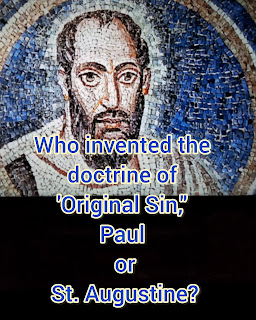
"Original Sin" doctrine who Invented it?


PAUL INVENTED THE DOCTRINE OF "ORIGINAL SIN," not St. Augustine

WHY DR. LITWA AND GOOGLE MUST BE REJECTED

You will see why they need to be rejected through this letter I wrote

**********************

Jim,

You been watching a lot or too much of these shows and dont know reality or something.

I even brought up "original sin" on one of the shows here, where my question was a part of the program and the scholar mentioned that St. Augustine was the first to bring up "original sin." The scholar was Dr. M. David Litwa.

I would have to debate that because he (Augustine) gets the idea from Paul himself. Like: didn't the scholar know that? Paul himself, maybe, did not coin the phrase "original sin" but the doctrine came from Paul and that is very clear.

Here is what Google says when you type up:

"St. Augustine and Original Sin"

"Original sin is an Augustine Christian doctrine that says that everyone is born sinful. This means that they are born with a built-in urge to do bad things and to disobey God."

I say BS to Google and to Litwa for not knowing...


Here is what Paul wrote:

Romans 5
12¶Wherefore, as by one man sin entered into the world, and death by sin; and so death passed upon all men, for that all have sinned:
13 (For until the law sin was in the world: but sin is not imputed when there is no law.
14 Nevertheless death reigned from Adam to Moses, even over them that had not sinned after the similitude of Adam's transgression, who is the figure of him that was to come.
15 But not as the offence, so also is the free gift. For if through the offence of one many be dead....
.... Therefore as by the offence of one  came upon all men to condemnation

...19 For just as through the disobedience of the one man the many were made sinners

This is the true author of the "original sin" doctrine, not St. Augustine.

Here it is again:
1 Cor 15
20 But Christ has indeed been raised from the dead, the firstfruits of those who have fallen asleep.
21 For since death came through a man, the resurrection of the dead comes also through a man.
22 For as in Adam all die, so in Christ all will be made alive.

Here again, or continued from Romans 5....


ROMANS 7
7 What shall we say, then? Is the law sinful? Certainly not! Nevertheless, I would not have known what sin was had it not been for the law. For I would not have known what coveting really was if the law had not said, “You shall not covet.”
8 But sin, seizing the opportunity afforded by the commandment, produced in me every kind of coveting. For apart from the law, sin was dead.
9 Once I was alive apart from the law; but when the commandment came, sin sprang to life and I died.
10 I found that the very commandment that was intended to bring life actually brought death.
11 For sin, seizing the opportunity afforded by the commandment, deceived me, and through the commandment put me to death.
12 So then, the law is holy, and the commandment is holy, righteous and good.
13 Did that which is good, then, become death to me? By no means! Nevertheless, in order that sin might be recognized as sin, it used what is good to bring about my death, so that through the commandment sin might become utterly sinful.
14 We know that the law is spiritual; but I am unspiritual, sold as a slave to sin.
15 I do not understand what I do. For what I want to do I do not do, but what I hate I do.
16 And if I do what I do not want to do, I agree that the law is good.
17 As it is, it is no longer I myself who do it, but it is sin living in me.
18 For I know that good itself does not dwell in me, that is, in my sinful nature. For I have the desire to do what is good, but I cannot carry it out.
19 For I do not do the good I want to do, but the evil I do not want to do—this I keep on doing.
20 Now if I do what I do not want to do, it is no longer I who do it, but it is sin living in me that does it.
21 So I find this law at work: Although I want to do good, evil is right there with me.
22 For in my inner being I delight in God’s law;
23 but I see another law at work in me, waging war against the law of my mind and making me a prisoner of the law of sin at work within me.
24 What a wretched man I am! Who will rescue me from this body that is subject to death?
25 Thanks be to God, who delivers me through Jesus Christ our Lord! So then, I myself in my mind am a slave to God’s law, but in my sinful nature a slave to the law of sin.

SO LETS BE CLEAR....

PAUL  invented the doctrine of Original Sin.

Because sin didn't exist before Adam taking the fruit... he was good, according to Paul. But once he ate of the fruit he became a sinner.... and that sin was passed on to all his descendants. Adam was the first, thus that is the "original sin" doctrine and this "sin" or "spiritual stain" is passed on, according to Paul.

LITWA must be REJECTED and google.

I asked the question in the
"Dating Luke-Acts in light of Marcion" episode @ 1:01:27 (time)


Maregaal


#originalsin


Monday, January 24, 2022

Paul believed in the Demiurge


In this paper I discuss the personal beliefs of Paul and how he accepted this Demiurge character. This discussion got started after a person slammed me personally on a textual criticism forum.... so the first few original lines is dealing with that, but I chose to delete them here

***********

The "Jewish" messiah is merely a man, conceived naturally and born naturally. A direct descendant of David, Solomon, Hezekiah and Josiah. He literally conquers the enemies of Israel and all people regardless of them being enemies. So he conquers the world and he is king of the entire globe. His government shall be a theocratic monarchy. The Torah shall be the law code of his kingdom. That is the REAL Jewish messiah myth and legend.

Everything that the New Testament promotes is fake....

1) let's start with the premise... false = for God has no son, thus they are wrong from the get go.
2) he "must" be born in Bethlehem, false... rather his ancestry is from there
3) God contradicts Himself and makes Himself into a hypocrite by suddenly approving of a human sacrifice for sin, False
4) the messiah never dies
5) the messiah never dies in order to make an atonement for sin
6) the messiah ushers in a new covenant so that the Torah is no longer required (this is one of the most egregious ones and so opposite of the messiah myth)
7) the messiah ascends to heaven and will be gone for over 2,000 years before returning, false)

Most non-Jews don't know this. However, because you openly and blindly accept the New Testament as TRUTH or regard it as holding a great swath of truth, it is understandable why you believe the way you do and then apply that thinking on our book.

*************

Moving on

The  Gospels of Matthew and Luke say he was adopted by a dude named Joseph and that Joseph was of the line of David.

Ahhh, who cares about Joseph, it has nooooo bearing on the lineage of Jesus.

If you watched the video at all.... I point out that ONLY Paul claims something of worthiness,  2 things actually [for historical value]:

1) he was conceived naturally
2) he came from the sperma of David

Read Romans 1:3 clearly and in Greek.

Problem with Paul, he believed in the Demiurge philosophy which was circling around Israel at the time.  Between 50 BCE to 150 CE actually.

Paul then took the extra leap by assuming Jesus WAS this demiurge or logos character.

Thus, making this demigod type of being into flesh; this "craftsman" into flesh. Logos also meant craftsman at the time, not just "word" as you see in English texts in John 1.

So you can write, "In the beginning was the craftsman, and the craftsman was with God..."

This is sooooo foul of a doctrine it is pathetic... later the Gentile church leaders ... changed Jesus from this demiurge to fully God and a part of some Trinity goyish theology. 

You really need to do your homework on the Nicene council and understand Arius.... BECAUSE Arius represented Paul and John 1:1-18 correctly. 

Paul said in Col 1:15-17, that Jesus was a "created" being, created before the heavens and earth were created.

Learn something will you!!!

Col 1:15.... " He is.... the firstborn of every creature"

Lets see...

Firstborn is "prōtotokos / πρωτότοκος" which means....

The first to be born or to come into existence, whether of man, animal or spirits

"Creature" means beast, mankind or anything below God Himself

"Creature" is used in this following verse by Paul no less...

Romans 1:25
"Who changed the truth of God into a lie, and worshipped and served the creature more than the Creator, who is blessed for ever. Amen."

Paul is talking about the golden calf here. So, with Paul's theology, it is very clear Jesus is NOT the God of Israel in any way, shape or form. Rather, he is like a contractor working  for the God of Israel. Jesus being the heavenly craftsman in Paul's thinking

To summarize Paul's thinking in a nutshell:

HaShem told this Demiurge what to do and he did it for Him. In time, this pre-existing "creature" got incarnated in the man Jesus.

Now Paul DOESN'T say "how" this demiurge became flesh: 

Not whether this creature was inserted in the seed of Joseph and so no normal new soul was created. For many believe that the soul is created upon conception. Whereas others claim that all souls were created at the beginning and that they are inserted at conception.

...or whether this creature's spirit merely  rested upon Jesus (like some Ebionites believed, though that doesnt work, just making a point).

Yep, in truth, Paul doesn't get that deep, he just taught Jesus was conceived naturally as we see in Romans 1:3 and at the same time he was this logos.

Do yourself a favor, stop insulting everyone.

Shalom and Good Day,
Maregaal

********************
Some extra things
********************

If you want to know what the Jewish messiah is about, then try learning from a Jew that practices Judaism. I dont say this lightly either, but from one that can back up the messiah myth through the Tanach.

Any Judaic Jew knows these teachings

*) Daniel 2, he conquers the world.
*) Micah 5 ancestry is from Bethlehem
*) The Torah is his penal code Deut 17
*) The torah is forever Deut 4:40;
    12:28


Thank you,
Maregaal


Tuesday, January 18, 2022

Epic of Gilgamesh


THE EPIC OF GILGAMESH

Translated by Maureen Gallery Kovacs
Electronic Edition by Wolf Carnahan, I998

TABLET XI THE STORY OF THE FLOOD

Gilgamesh spoke to Utanapishtim, the Faraway:
"I have been looking at you,
but your appearance is not strange--you are like me!
You yourself are not different--you are like me!
My mind was resolved to fight with you,
(but instead?) my arm lies useless over you.
Tell me, how is it that you stand in the Assembly of the Gods,
and have found life!"
Utanapishtim spoke to Gilgamesh, saying:
"I will reveal to you, Gilgamesh, a thing that is hidden,
a secret of the gods I will tell you!
Shuruppak, a city that you surely know,
situated on the banks of the Euphrates,
that city was very old, and there were gods inside it.
The hearts of the Great Gods moved them to inflict the Flood.
Their Father Anu uttered the oath (of secrecy),
Valiant Enlil was their Adviser,
Ninurta was their Chamberlain,
Ennugi was their Minister of Canals.
Ea, the Clever Prince(?), was under oath with them
so he repeated their talk to the reed house:
'Reed house, reed house! Wall, wall!
O man of Shuruppak, son of Ubartutu:
Tear down the house and build a boat!
Abandon wealth and seek living beings!
Spurn possessions and keep alive living beings!
Make all living beings go up into the boat.
The boat which you are to build,
its dimensions must measure equal to each other:
its length must correspond to its width.
Roof it over like the Apsu.
I understood and spoke to my lord, Ea:
'My lord, thus is the command which you have uttered
I will heed and will do it.
But what shall I answer the city, the populace, and the
Elders!'
Ea spoke, commanding me, his servant:
'You, well then, this is what you must say to them:
"It appears that Enlil is rejecting me
so I cannot reside in your city (?),
nor set foot on Enlil's earth.
I will go down to the Apsu to live with my lord, Ea,
and upon you he will rain down abundance,
a profusion of fowl, myriad(!) fishes.
He will bring to you a harvest of wealth,
in the morning he will let loaves of bread shower down,
and in the evening a rain of wheat!"'
Just as dawn began to glow
the land assembled around me-
the carpenter carried his hatchet,
the reed worker carried his (flattening) stone,
... the men ...
The child carried the pitch,
the weak brought whatever else was needed.
On the fifth day I laid out her exterior.
It was a field in area,
its walls were each 10 times 12 cubits in height,
the sides of its top were of equal length, 10 times It cubits each.
I laid out its (interior) structure and drew a picture of it (?).
I provided it with six decks,
thus dividing it into seven (levels).
The inside of it I divided into nine (compartments).
I drove plugs (to keep out) water in its middle part.
I saw to the punting poles and laid in what was necessary.
Three times 3,600 (units) of raw bitumen I poured into the
bitumen kiln,
three times 3,600 (units of) pitch ...into it,
there were three times 3,600 porters of casks who carried (vege-
table) oil,
apart from the 3,600 (units of) oil which they consumed (!)
and two times 3,600 (units of) oil which the boatman stored
away.
I butchered oxen for the meat(!),
and day upon day I slaughtered sheep.
I gave the workmen(?) ale, beer, oil, and wine, as if it were
river water,
so they could make a party like the New Year's Festival.
... and I set my hand to the oiling(!).
The boat was finished by sunset.
The launching was very difficult.
They had to keep carrying a runway of poles front to back,
until two-thirds of it had gone into the water(?).
Whatever I had I loaded on it:
whatever silver I had I loaded on it,
whatever gold I had I loaded on it.
All the living beings that I had I loaded on it,
I had all my kith and kin go up into the boat,
all the beasts and animals of the field and the craftsmen I
had go up.
Shamash had set a stated time:
'In the morning I will let loaves of bread shower down,
and in the evening a rain of wheat!
Go inside the boat, seal the entry!'
That stated time had arrived.
In the morning he let loaves of bread shower down,
and in the evening a rain of wheat.
I watched the appearance of the weather--
the weather was frightful to behold!
I went into the boat and sealed the entry.
For the caulking of the boat, to Puzuramurri, the boatman,
I gave the palace together with its contents.
Just as dawn began to glow
there arose from the horizon a black cloud.
Adad rumbled inside of it,
before him went Shullat and Hanish,
heralds going over mountain and land.
Erragal pulled out the mooring poles,
forth went Ninurta and made the dikes overflow.
The Anunnaki lifted up the torches,
setting the land ablaze with their flare.
Stunned shock over Adad's deeds overtook the heavens,
and turned to blackness all that had been light.
The... land shattered like a... pot.
All day long the South Wind blew ...,
blowing fast, submerging the mountain in water,
overwhelming the people like an attack.
No one could see his fellow,
they could not recognize each other in the torrent.
The gods were frightened by the Flood,
and retreated, ascending to the heaven of Anu.
The gods were cowering like dogs, crouching by the outer wall.
Ishtar shrieked like a woman in childbirth,
the sweet-voiced Mistress of the Gods wailed:
'The olden days have alas turned to clay,
because I said evil things in the Assembly of the Gods!
How could I say evil things in the Assembly of the Gods,
ordering a catastrophe to destroy my people!!
No sooner have I given birth to my dear people
than they fill the sea like so many fish!'
The gods--those of the Anunnaki--were weeping with her,
the gods humbly sat weeping, sobbing with grief(?),
their lips burning, parched with thirst.
Six days and seven nights
came the wind and flood, the storm flattening the land.
When the seventh day arrived, the storm was pounding,
the flood was a war--struggling with itself like a woman
writhing (in labor).
The sea calmed, fell still, the whirlwind (and) flood stopped up.
I looked around all day long--quiet had set in
and all the human beings had turned to clay!
The terrain was as flat as a roof.
I opened a vent and fresh air (daylight!) fell upon the side of
my nose.
I fell to my knees and sat weeping,
tears streaming down the side of my nose.
I looked around for coastlines in the expanse of the sea,
and at twelve leagues there emerged a region (of land).
On Mt. Nimush the boat lodged firm,
Mt. Nimush held the boat, allowing no sway.
One day and a second Mt. Nimush held the boat, allowing
no sway.
A third day, a fourth, Mt. Nimush held the boat, allowing
no sway.
A fifth day, a sixth, Mt. Nimush held the boat, allowing
no sway.
When a seventh day arrived
I sent forth a dove and released it.
The dove went off, but came back to me;
no perch was visible so it circled back to me.
I sent forth a swallow and released it.
The swallow went off, but came back to me;
no perch was visible so it circled back to me.
I sent forth a raven and released it.
The raven went off, and saw the waters slither back.
It eats, it scratches, it bobs, but does not circle back to me.
Then I sent out everything in all directions and sacrificed
(a sheep).
I offered incense in front of the mountain-ziggurat.
Seven and seven cult vessels I put in place,
and (into the fire) underneath (or: into their bowls) I poured
reeds, cedar, and myrtle.
The gods smelled the savor,
the gods smelled the sweet savor,
and collected like flies over a (sheep) sacrifice.
Just then Beletili arrived.
She lifted up the large flies (beads) which Anu had made for
his enjoyment(!):
'You gods, as surely as I shall not forget this lapis lazuli
around my neck,
may I be mindful of these days, and never forget them!
The gods may come to the incense offering,
but Enlil may not come to the incense offering,
because without considering he brought about the Flood
and consigned my people to annihilation.'
Just then Enlil arrived.
He saw the boat and became furious,
he was filled with rage at the Igigi gods:
'Where did a living being escape?
No man was to survive the annihilation!'
Ninurta spoke to Valiant Enlil, saying:
'Who else but Ea could devise such a thing?
It is Ea who knows every machination!'
La spoke to Valiant Enlil, saying:
'It is yours, O Valiant One, who is the Sage of the Gods.
How, how could you bring about a Flood without consideration
Charge the violation to the violator,
charge the offense to the offender,
but be compassionate lest (mankind) be cut off,
be patient lest they be killed.
Instead of your bringing on the Flood,
would that a lion had appeared to diminish the people!
Instead of your bringing on the Flood,
would that a wolf had appeared to diminish the people!
Instead of your bringing on the Flood,
would that famine had occurred to slay the land!
Instead of your bringing on the Flood,
would that (Pestilent) Erra had appeared to ravage the land!
It was not I who revealed the secret of the Great Gods,
I (only) made a dream appear to Atrahasis, and (thus) he
heard the secret of the gods.
Now then! The deliberation should be about him!'
Enlil went up inside the boat
and, grasping my hand, made me go up.
He had my wife go up and kneel by my side.
He touched our forehead and, standing between us, he
blessed us:
'Previously Utanapishtim was a human being.
But now let Utanapishtim and his wife become like us,
the gods!
Let Utanapishtim reside far away, at the Mouth of the Rivers.'
They took us far away and settled us at the Mouth of the Rivers."
"Now then, who will convene the gods on your behalf,
that you may find the life that you are seeking!
Wait! You must not lie down for six days and seven nights."
soon as he sat down (with his head) between his legs
sleep, like a fog, blew upon him.
Utanapishtim said to his wife:
"Look there! The man, the youth who wanted (eternal) life!
Sleep, like a fog, blew over him."
his wife said to Utanapishtim the Faraway:
"Touch him, let the man awaken.
Let him return safely by the way he came.
Let him return to his land by the gate through which he left."
Utanapishtim said to his wife:
"Mankind is deceptive, and will deceive you.
Come, bake loaves for him and keep setting them by his head
and draw on the wall each day that he lay down."
She baked his loaves and placed them by his head
and marked on the wall the day that he lay down.
The first loaf was dessicated,
the second stale, the third moist(?), the fourth turned white,
its ...,
the fifth sprouted gray (mold), the sixth is still fresh.
the seventh--suddenly he touched him and the man awoke.
Gilgamesh said to Utanapishtim:
"The very moment sleep was pouring over me
you touched me and alerted me!"
Utanapishtim spoke to Gilgamesh, saying:
"Look over here, Gilgamesh, count your loaves!
You should be aware of what is marked on the wall!
Your first loaf is dessicated,
the second stale, the third moist, your fourth turned white,
its ...
the fifth sprouted gray (mold), the sixth is still fresh.
The seventh--suddenly he touched him and the man awoke.
Gilgamesh said to Utanapishtim:
"The very moment sleep was pouring over me
you touched me and alerted me!"
Utanapishtim spoke to Gilgamesh, saying:
"Look over here, Gilgamesh, count your loaves!
You should be aware of what is marked on the wall!
Your first loaf is dessicated,
the second stale, the third moist, your fourth turned white,
its ...
the fifth sprouted gray (mold), the sixth is still fresh.
The seventh--at that instant you awoke!"
Gilgamesh said to Utanapishtim the Faraway:
"O woe! What shall I do, Utanapishtim, where shall I go!
The Snatcher has taken hold of my flesh,
in my bedroom Death dwells,
and wherever I set foot there too is Death!"
Home Empty-Handed
Utanapishtim said to Urshanabi, the ferryman:
"May the harbor reject you, may the ferry landing reject you!
May you who used to walk its shores be denied its shores!
The man in front of whom you walk, matted hair chains
his body,
animal skins have ruined his beautiful skin.
Take him away, Urshanabi, bring him to the washing place.
Let him wash his matted hair in water like ellu.
Let him cast away his animal skin and have the sea carry it off,
let his body be moistened with fine oil,
let the wrap around his head be made new,
let him wear royal robes worthy of him!
Until he goes off to his city,
until he sets off on his way,
let his royal robe not become spotted, let it be perfectly new!"
Urshanabi took him away and brought him to the washing place.
He washed his matted hair with water like ellu.
He cast off his animal skin and the sea carried it oh.
He moistened his body with fine oil,
and made a new wrap for his head.
He put on a royal robe worthy of him.
Until he went away to his city,
until he set off on his way,
his royal robe remained unspotted, it was perfectly clean.
Gilgamesh and Urshanabi bearded the boat,
they cast off the magillu-boat, and sailed away.
The wife of Utanapishtim the Faraway said to him:
"Gilgamesh came here exhausted and worn out.
What can you give him so that he can return to his land (with
honor) !"
Then Gilgamesh raised a punting pole
and drew the boat to shore.
Utanapishtim spoke to Gilgamesh, saying:
"Gilgamesh, you came here exhausted and worn out.
What can I give you so you can return to your land?
I will disclose to you a thing that is hidden, Gilgamesh,
a... I will tell you.
There is a plant... like a boxthorn,
whose thorns will prick your hand like a rose.
If your hands reach that plant you will become a young
man again."
Hearing this, Gilgamesh opened a conduit(!) (to the Apsu)
and attached heavy stones to his feet.
They dragged him down, to the Apsu they pulled him.
He took the plant, though it pricked his hand,
and cut the heavy stones from his feet,
letting the waves(?) throw him onto its shores.
Gilgamesh spoke to Urshanabi, the ferryman, saying:
"Urshanabi, this plant is a plant against decay(!)
by which a man can attain his survival(!).
I will bring it to Uruk-Haven,
and have an old man eat the plant to test it.
The plant's name is 'The Old Man Becomes a Young Man.'"
Then I will eat it and return to the condition of my youth."
At twenty leagues they broke for some food,
at thirty leagues they stopped for the night.
Seeing a spring and how cool its waters were,
Gilgamesh went down and was bathing in the water.
A snake smelled the fragrance of the plant,
silently came up and carried off the plant.
While going back it sloughed off its casing.'
At that point Gilgamesh sat down, weeping,
his tears streaming over the side of his nose.
"Counsel me, O ferryman Urshanabi!
For whom have my arms labored, Urshanabi!
For whom has my heart's blood roiled!
I have not secured any good deed for myself,
but done a good deed for the 'lion of the ground'!"
Now the high waters are coursing twenty leagues distant,'
as I was opening the conduit(?) I turned my equipment over
into it (!).
What can I find (to serve) as a marker(?) for me!
I will turn back (from the journey by sea) and leave the boat by
the shore!"
At twenty leagues they broke for some food,
at thirty leagues they stopped for the night.
They arrived in Uruk-Haven.
Gilgamesh said to Urshanabi, the ferryman:
"Go up, Urshanabi, onto the wall of Uruk and walk around.
Examine its foundation, inspect its brickwork thoroughly--
is not (even the core of) the brick structure of kiln-fired brick,
and did not the Seven Sages themselves lay out its plan!
One league city, one league palm gardens, one league lowlands, the open area(?) of the Ishtar Temple,
three leagues and the open area(?) of Uruk it encloses.